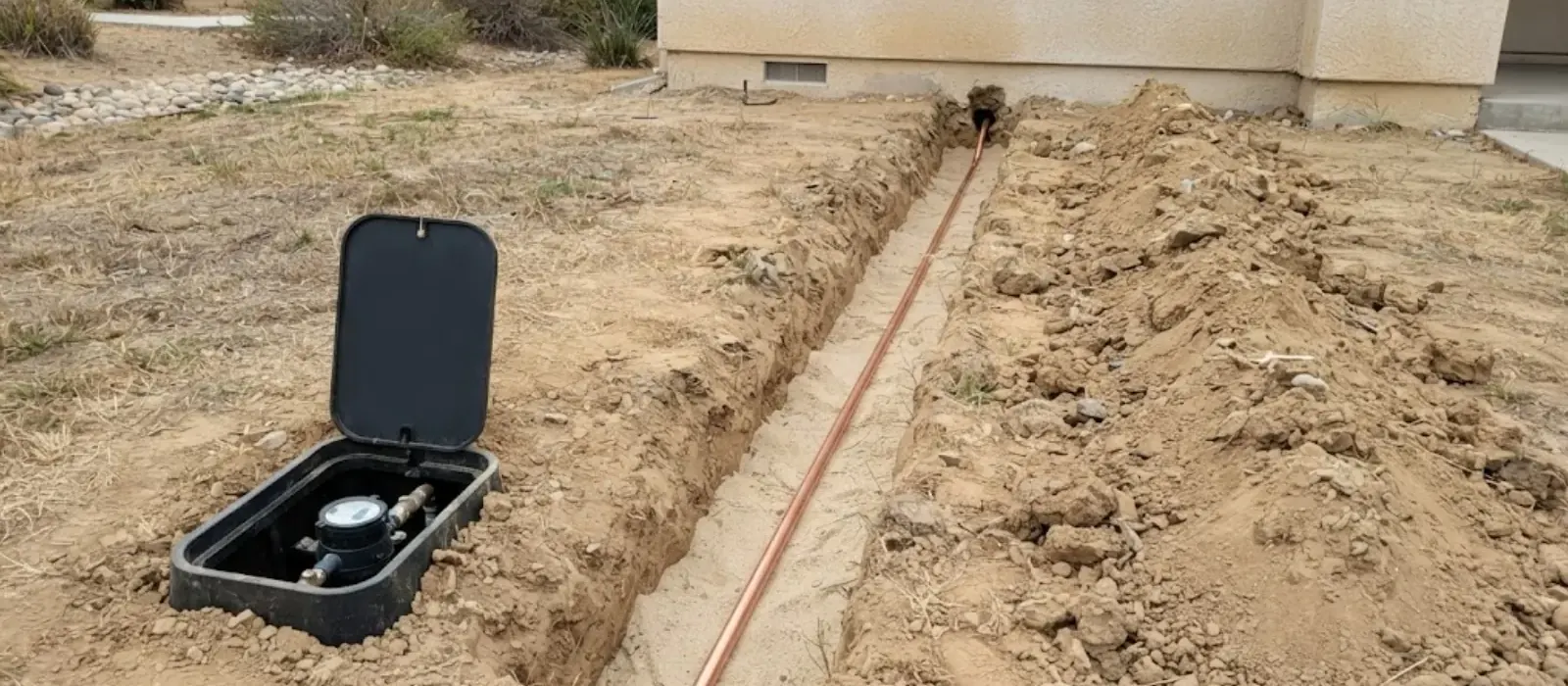
Emergency Water Service Line Repair in Loma Linda, CA
The pipe between the street meter and your front wall is buried, shared with nobody, and easy to forget until the yard floods or the pressure sags across the whole house.
Water Service Line Repair help, day or night
Water flooding the yard or running from the meter box? Shut it off first
A water service line leak is an emergency when the yard is flooding, water runs from the meter box, or pressure collapses. The line is open 24/7, and a water service line is the buried pipe that carries city water from the meter to your house. Shut the main valve at the house, stop using water, and keep children and pets away from soft, saturated ground.
Water pooling at the curb or in the street is a different case. If it is on the street side of the meter, the city's after-hours water, sewer, and street emergency line at (909) 356-3805 is the right call. For anything between the meter and your front wall, call the plumber.
- Close the main valve where the line enters the house and check that the meter stops.
- Do not dig into wet ground yourself. A buried line may sit near gas, electric, or other utilities.
- Photograph the wet area and the meter reading.
- Call and say where the water shows and what the pressure is doing indoors.
Night and weekend breaks are the same job. Same-day appointments are offered when the schedule allows, and the line is answered after hours.
Low pressure, a soggy lawn, and a higher bill: is it the service line?
A failing service line seldom gives one clean symptom. You might notice a shower that has turned weak, a lawn strip that stays soggy in dry weather, and a bill that rose two cycles in a row, all within a few weeks.
Together they point at the same thing. A leak in the buried line lets some water escape before it reaches the house, so pressure drops at every tap, not just one. Soil can swallow the leak for a long time, which is why the first clue is often the bill.
A quick test helps. Turn off all water in the house, read the meter, and read it again after two hours. If the number moved, close the main valve and test again. A meter that still moves with the house valve shut means the leak is outside, between the meter and your house or beyond it.
Whose pipe is it? The meter draws the line
The utility meter is the usual dividing point. The city handles the system on its side, and the pipe from the meter to your structure belongs to the homeowner. The state's plumbing contractor classification covers water lines from the owner's side of the utility meter to the structure, so a licensed plumber is the right person for the work.
Lead is a fair question for older lines. Water systems were required to file a service line inventory with the State Water Board by October 16, 2024. That inventory covers the system-owned line to the meter, not the homeowner's side. Ask the city water department about your specific line, and ask the plumber what material your portion is made from before any work starts.
For billing questions, the city's Finance Department answers at (909) 799-2845, Monday through Thursday, 7:00 to 5:30.
Why older lines fail
About 42.5 percent of Loma Linda homes were built before 1980, and the Census median year built is 1984. A line laid in that era may be galvanized steel, older copper, or another material that has been wet and buried for decades. Galvanized pipe rusts from the inside out, narrows, and fails at joints, while copper pinholes where soil and water are aggressive.
The practical lesson is to ask about the whole run, not only the leak, since a house with failing lines throughout may be a candidate for repiping. A patch on a line that is thin along its full length buys a short reprieve. If the pipe is in good shape except for one spot, a spot repair is reasonable.
Ground movement, tree roots, and heavy equipment above the line can also stress a buried pipe. Pressure surges when valves close suddenly add to wear at fittings, and a split that shows up inside the house is handled as burst pipe repair. None of these show on the surface, so the diagnosis starts with testing, not digging, and a survey like leak detection is where it begins.
Low water pressure at every tap
Weak pressure throughout the house is the second most useful symptom after a moving meter, because it points toward the supply side. A leak, a partly closed valve, a failing pressure regulator, or a narrowed galvanized pipe can all cause it.
The plumber checks the simple causes first. Is the main valve fully open? Is the pressure regulator, if the house has one, working? Is the pressure low only when other fixtures run? Then the meter test and a pressure gauge on a hose bib show whether the loss is in the line.
The city's water system is divided into five pressure zones, so pressure can differ between neighborhoods and change if the city is doing work nearby. Ask whether anything changed on the street side before you pay to dig on yours. If every tap is weak, the neighbors' pressure is normal, and the meter moves with the house valve closed, the service line is the likely cause.
How the break is confirmed before anyone digs
| Test | What it shows | Limit |
|---|---|---|
| Meter test with the house valve closed | The leak is outside the house | Does not give a location |
| Pressure test of the line | Whether the line holds pressure | Needs the line isolated |
| Line locator | The path and depth of the buried pipe | Does not show the leak by itself |
| Ground-listening equipment | The sound of water escaping near the leak | Traffic and irrigation can mask the sound |
Before any digging, dial 811. The one-call center notifies the utilities, and the safe lead time is at least two business days. A plumber who skips the call risks a gas or electric strike, so ask whether it has been made.
Once the spot is confirmed, the opening is cut over the break, not along the whole line. A short excavation is faster, cheaper to restore, and less disruptive to the yard than a long trench.
Repair or replace the line: what the choice looks like
| Option | Best when | Trade-off |
|---|---|---|
| Spot repair at the leak | One leak on a line that is otherwise sound | The next failure can come soon if the pipe is worn |
| Replace the line in a trench | The pipe is old, corroded, or has leaked more than once | Digging and yard or paving repair |
| Trenchless replacement | Driveways, patios, or landscaping that you want to keep | Needs entry and exit pits, and not every route suits it |
| Install a new line for a new connection | New construction or an addition | Planned work, with inspections along the way |
Plumbing work needs its own permit in Loma Linda, according to the city's building FAQ, and the same page says inspection is needed before pipes buried below grade are covered. Ask the Loma Linda Building and Safety Division what applies to your job, and do not let anyone backfill a new line before the inspection question is answered.
Meter boxes, yard leaks, and new construction hookups
Water pooling in or around the meter box can come from either side. If the meter itself or the connection before it is leaking, that is the city's. If the fitting after the meter is leaking, it belongs to the homeowner. Do not open or dig around the box yourself, and call the right number for the side you see.
New construction needs a service line from the meter to the building, and the same rules about testing and inspection apply. A plumber serving Loma Linda and nearby Grand Terrace can plan the trench route, the shut-off location, and the connection point with the building plans in hand. Because the line will be buried, it is worth getting the material and depth right the first time.
What drives the cost of a service line repair
- Length and depth of the line, and how far the excavation must run.
- What sits on top of it: lawn, concrete, pavers, or a driveway.
- Pipe material and size for the new section.
- Whether the repair is a spot fix, a trench replacement, or a trenchless method.
- Permit and inspection steps, and after-hours work at night or on weekends.
Many homeowner policies cover sudden and accidental water damage, while the California Department of Insurance lists seepage, leaks over time, and wear as generally not covered. A buried line that has leaked slowly may fall into the second kind, so ask your insurer before work starts. Photograph the area and keep the plumber's written findings.
Want your real number for your house? Call (909) 505-3225 and you hear a clear price before any work starts.
Service line questions in Loma Linda
Yes. The line is open 24/7, including nights, weekends, and holidays, and a yard that is flooding or a line that has lost all pressure is handled as urgent. Same-day appointments are offered when the schedule allows. Shut the main valve at the house and stay off saturated ground while you wait.
The utility meter is the usual dividing point. Close the main valve at the house and watch the meter. If it still moves, the leak is outside the house, either between the meter and the house or on the city side. Street-side problems go to the city's after-hours line, and the plumber handles the rest.
A leak in the buried line, a partly closed valve, a worn pressure regulator, or an old narrowed galvanized pipe can all do it. A meter test and a pressure gauge show which one it is. Ask the city whether work on the street changed anything first.
Plumbing work needs its own permit in Loma Linda, according to the city's building FAQ, and rules for your specific job vary. Ask the Loma Linda Building and Safety Division before work begins. To check any plumber's licence, use the CSLB license lookup at cslb.ca.gov.
Yes. Dial 811 before any digging, at least two business days ahead. It notifies the utilities so buried gas and electric lines are marked.
Ask the city water department about the line on its side, and ask the plumber about the material on yours. The state's inventory covers system-owned lines to the meter, not the homeowner's portion.
Sometimes. A trenchless method needs small pits at each end instead of a continuous trench, and it depends on the route and the soil. The plumber can tell you whether it suits your property after the line is located.
Get the buried line tested and fixed
Call any hour about water in the yard or low pressure. You hear a clear price before work starts, and same-day appointments are available when the schedule allows.
Call (909) 505-3225Dispatched from Loma Linda
Crews head out from Loma Linda to the neighborhoods below and the towns around them.