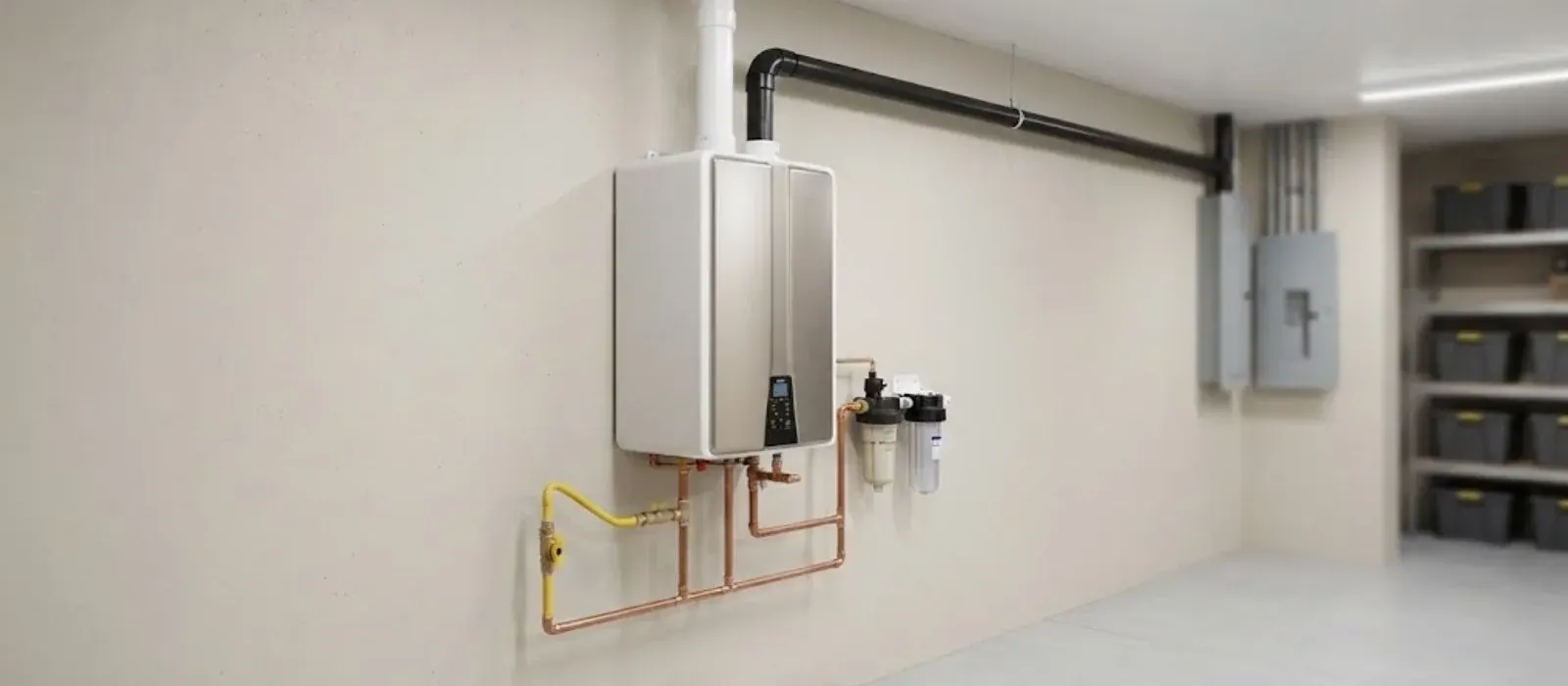
Tankless Water Heater in Loma Linda, CA
Tankless heaters make hot water on demand, but Loma Linda's well water leaves scale inside the heat exchanger if the unit is never flushed.
Tankless Water Heater help, day or night
Hot water that goes lukewarm, then cold: what is going on?
A tankless water heater is a wall-mounted unit that heats water as it flows, with no storage tank holding a supply. When it misbehaves, the symptoms are specific. The shower runs hot, drops to lukewarm, then turns cold. The unit shows an error code. The flame starts and stops. Water takes a long time to turn warm. Each pattern points to a different cause.
Lukewarm water that fades over weeks usually means scale has built up inside the heat exchanger and slowed heat transfer. A cold burst between two hot ones often comes from low flow. A faucet running too gently may not trigger the unit, and a clogged inlet screen can starve it. An error code can point to a vent problem, a flame problem or a blocked water path, and the code table in the manual narrows it down.
Scale, well water and why Loma Linda units need attention
The city serves water drawn from its own wells in the Bunker Hill Basin, with chlorine added for disinfection. The utility's 2025 report treats hardness unevenly, showing it by well and again on a second line with a different average. That means scale buildup depends on which well serves your street, and no single number is safe to assume.
The practical step is simple. Test your tap with a hardness kit, or ask the water department for its annual report, then plan the flush schedule around what you learn. A house on harder water needs its tankless unit flushed more often than a house on softer water. If tests show heavy scale, a water softener or filtration system can reduce how fast the heat exchanger clogs.
Flush and descale: how a tankless heater is cleaned
A flush and descale clears mineral scale from inside the heat exchanger, which is the narrow set of tubes where the water picks up heat. Without it, those tubes narrow, the unit works harder and the output temperature drifts. This is the most common service on tankless heaters, and it is also the one most often skipped.
The plumber closes the unit's water and gas valves, then connects hoses to service valves on the hot and cold lines. A small descaling pump circulates a food-grade descaling solution, often white vinegar, through the exchanger for a set period. Then the unit is rinsed with clean water, the inlet screen is cleaned, and the valves are reopened and tested.
If your unit has no service valves, the plumber can add them during the visit, which makes every later flush faster. The visit ends with a flow and temperature test, a check of the vent and a look at the error history. How often the flush should happen depends on your tap test and the maker's instructions, so the plumber sets an interval for your home.
How the problem is traced on a tankless heater
A tankless diagnosis starts with the display. The plumber reads the error code and the unit's history, then checks the flow rate at a fixture to see whether the heater is firing at all. Water pressure and the inlet screen come next, because low flow is a common reason for a cold burst.
On the gas side, the plumber checks the gas supply, the line size for the unit's rating and the flame sensor. On the exhaust side, the vent route and the connections are inspected for blockage or damage, using the maker's instructions and the California Plumbing Code as the reference. A temperature probe at the outlet shows whether the exchanger is delivering what it should.
Gas safety around a tankless unit
Tankless gas heaters draw a lot of fuel and a lot of air, so the gas line and vent are the safety core of the unit. A gas smell near the unit means hands off the controls. Walk out, then reach SoCalGas on 1-800-427-2200 from a safe place, or reach 911 when they cannot be reached or anyone is endangered.
The plumber is next in line once the utility has cleared the house. Gas line work and venting are customer-side plumbing, and the plumbing classification from the state license board covers gas appliances, flues and connections. If a job calls for a building permit, state rules put it in licensed hands at any price.
Replacing a tank with a tankless unit
A tankless swap is more than hanging a box on the wall. The old tank comes out, the gas line is checked for size against the new unit's rating, the vent is rerouted, and the water lines get isolation valves for flushing. An electric tankless unit needs a heavy circuit at the panel, so the plumber looks at the capacity of your electrical service too.
Whether a tankless project needs a permit is a question for the city. The Building and Safety Division handles plumbing permits for Loma Linda, and its pages are silent on water heaters. For a broader view of planning a new heater, see the page on water heater installation.
Tankless or tank: how the two compare
| Question | Tankless | Tank |
|---|---|---|
| Hot water supply | Heats on demand, with output limited by flow rate | Stored supply, can run out |
| Space | Wall-mounted, frees floor space | Needs a closet or garage footprint |
| Maintenance | Needs a periodic flush and descale | Needs periodic draining and an anode check |
| Install work | Gas line, vent and circuit may need upgrades | Often reuses existing connections |
| Failure pattern | Scale, error codes, sensors | Tank corrosion and leaks |
The honest trade-off is cost against fit. A tankless unit costs more to install in many homes, especially where the gas line or vent must change, and it needs regular care. It does reward homes that have space limits or large hot-water demand spread across a day. If your tank is leaking and you need a fast fix, water heater replacement is the quicker route.
Rebates, climate and old-house details
SoCalGas lists rebates for high-efficiency gas storage and tankless water heaters. Funds are first come, first served, run through December 31, 2026 and may change without notice, so check the SoCalGas rebate page before you buy. Ask the plumber which models qualify. Do not assume a rebate until the program confirms it for your address.
The nearest long-record NOAA station, in Redlands, counts roughly 25 days a year that reach 100 degrees or more and only about 3 days of freezing. A tankless unit inside a garage or on an outside wall works in high heat during most summers, so ventilation and the vent run matter. Freeze protection is a smaller worry, though a unit on an exterior wall still needs power on to protect itself.
In the city, 42.5 percent of homes predate 1980. In those houses, the gas line and the old water lines near the heater deserve a look before a high-demand unit is attached. Tankless calls come from Colton and Highland too, and we serve both.
Fixing an existing unit or flushing before it fails
Many tankless owners call only after a unit fails. A planned flush costs less than a repair after the exchanger has clogged. Signs that you should schedule one soon include longer waits for hot water, temperature swings, a unit that is louder than before and an error code that clears after a reset but returns.
If the unit has already shut down, the plumber starts with a repair plan, and a water heater repair call covers the diagnostic steps. When parts are worn beyond a flush, you get a straight answer on repair versus replacement.
Pricing factors for tankless work
- Whether the visit is a flush, a repair, or a full installation
- Gas line size, vent route and electrical capacity at the install location
- Brand and model, since parts and service steps differ
- Whether isolation valves need to be added for a flush
- Scale condition of the heat exchanger and the water treatment you choose
Homeowner insurance usually treats a sudden burst differently from slow seepage. A tankless unit weeping from a corroded fitting may land on the wear side of that line, so ask your insurer and take photos.
Need a real figure for your unit? Call (909) 505-3225 and the price for your unit is spelled out before work starts.
Tankless water heater questions
It depends on your water and the maker's instructions. Loma Linda's hardness varies by well, so test your tap first. A house with harder water needs flushing more often, and the plumber can set an interval after reading the unit and the water results.
Common causes are low flow that does not keep the unit firing, a clogged inlet screen, or scale in the heat exchanger. The plumber checks flow and pressure first, then the screen, then the exchanger, so the cause is found and not guessed.
The plumber isolates the unit, runs a descaling solution through the heat exchanger with a small pump, rinses it, cleans the inlet screen and tests the output. Service valves make the job easier, and they can be added if the unit lacks them.
It can be, if you want to open up floor space and your gas line and vent can handle it. The trade-off is higher install work and regular flushing. SoCalGas lists rebates for efficient tankless models, though funds can run out.
Call the city's Building and Safety Division, which issues plumbing permits and does not list water heaters on its pages. Work that does need a permit must be done by a licensed contractor.
Exit without touching switches, and phone SoCalGas on 1-800-427-2200. Use 911 if they cannot be reached. Hold the plumber call until the utility clears the house.
Tankless install, repair or flush? Call a licensed plumber
Give us the brand, the error code and how old the unit is. A licensed plumber explains the fix and a clear price before work begins.
Call (909) 505-3225Dispatched from Loma Linda
Crews head out from Loma Linda to the neighborhoods below and the towns around them.