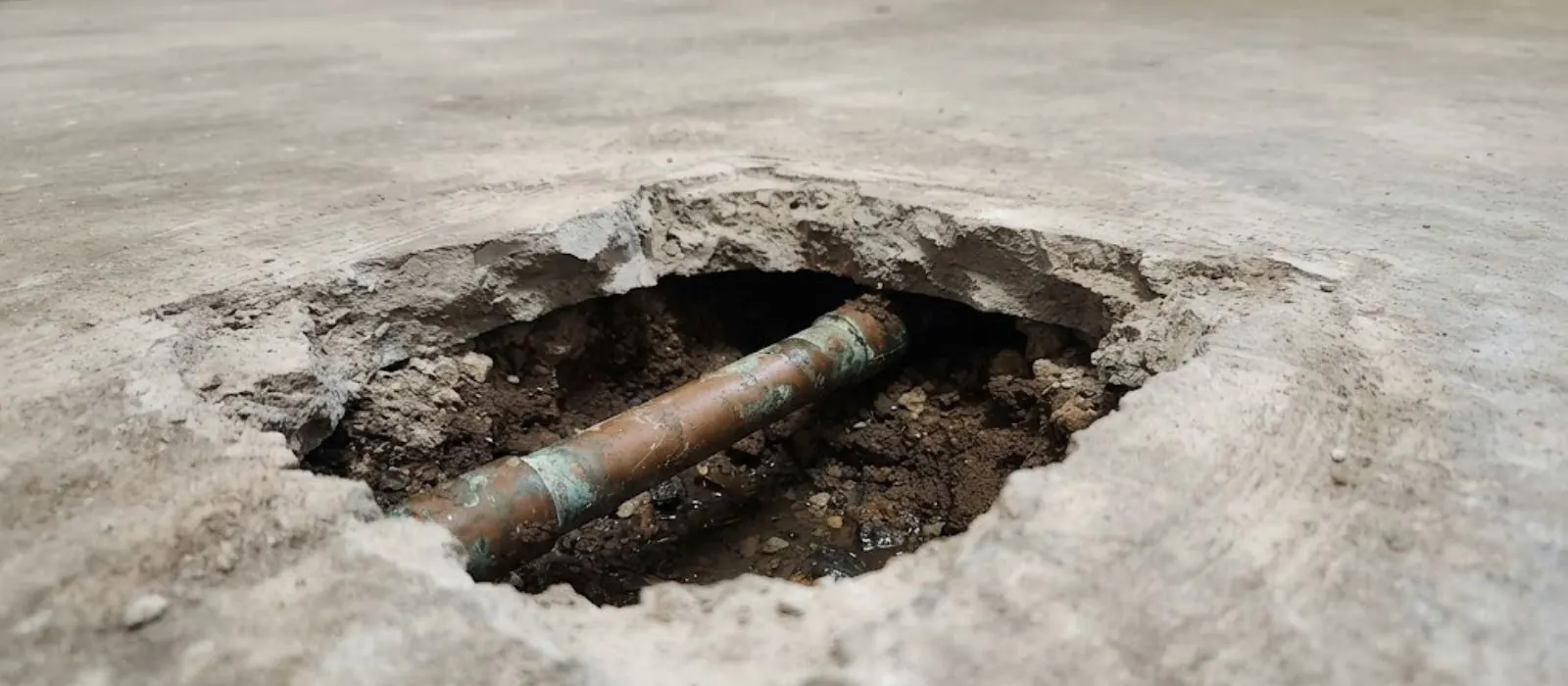
Emergency Slab Leak Repair in Loma Linda, CA
A warm patch on the floor, a faint rush of water under the tile, or a bill that jumped can all mean a slab leak, and the line is open all night in Loma Linda.
Slab Leak Repair help, day or night
Water under the floor right now? Start here
A slab leak is an emergency when the floor is wet, the flooring is lifting, or the meter spins with everything off. The line is open 24/7, and slab leak repair means finding a pipe that is leaking in or beneath the concrete foundation and fixing it with the smallest opening possible. Shut the main valve first, then stop using water and keep everyone off any warm or damp floor.
If the wet area reaches outlets, baseboard wiring, or a floor-level appliance, stay out of the room. Cut power at the panel only if you can get there on dry ground. Turn off the water heater too if the leak is on the hot side, since a heater that keeps refilling can feed the leak.
A leak that starts at night or on a weekend still gets answered, whether the house is in Loma Linda or in nearby Redlands. Same-day appointments are offered when the schedule allows, and after-hours calls go to the same line as daytime ones.
- Close the main shut-off valve and confirm that the meter stops.
- Photograph damp flooring, warm spots, and the meter reading.
- Lift small rugs and move furniture off wet areas so the floor can dry.
- Call and tell the plumber what you hear, feel, and see, and where.
Warm floor spot and a hum under the tile: is that a slab leak?
Slab leaks rarely announce themselves with a flood. They show up as small signals that do not fit together. A patch of floor feels warm in a room that is otherwise cool, or you hear water running faintly when every fixture is off, or the water heater seems to run all day.
A warm spot usually means a hot water line is leaking in or under the concrete and heating the surface above it. A sound of running water at night is a pressurized line that is losing flow. A bill that jumps with no change in use ties the two together.
None of these signs proves a slab leak, because a toilet flapper or a hidden wall leak can raise a bill too. That is why the meter test comes first. Close the main valve at the house, and if the meter stops, the leak is on the house side. If it keeps moving, the loss is outside, and water service line repair may be the right path.
Why older Loma Linda pipes matter under concrete
The Census survey for Loma Linda puts about 42.5 percent of homes as built before 1980, and the median year built is 1984. Pipes of that age have had decades of wear, flow, and soil contact. Many of those homes have copper or galvanized lines, which can develop pinhole leaks or corrode from inside.
The city's pages do not say which homes sit on slabs. If yours does, the pipes that run through or under it are hard to reach and costly to replace if they fail. Ask the plumber about the pipe material, its age, and whether one repair is likely to hold or whether more leaks are coming.
Newer homes are not exempt. About 27.2 percent of the city's homes were built in 2000 or later. A fitting that was poorly joined, a pipe rubbing on rough concrete, or a joint put under stress can leak at any age, so a newer slab can leak too.
Signs the leak is under the slab
- A warm or hot spot on tile, laminate, or concrete that moves with the hot water.
- The sound of running water, hissing, or clicking in a quiet house.
- A water bill that rises with no change in how the household uses water.
- A meter that moves when all fixtures are off and the main valve is open.
- Damp carpet, lifting floorboards, or a floor that feels cool and wet in one patch.
- Cracks in tile or grout lines that were not there before.
- A musty smell near baseboards or along an outside wall.
- Low hot water pressure, or a water heater that seems to run more than usual.
How a leak is pinpointed beneath concrete
Cutting the slab on a guess is the expensive mistake, so the search comes first. The plumber starts with the meter test and then isolates each water line by shutting valves and pressure testing it. That reveals whether the leak is on the hot side, the cold side, or both.
Next comes electronic leak detection. Listening equipment picks up the sound that water makes when it escapes a pressurized pipe, and the sound is strongest directly over the leak. A thermal camera can show a hot water line leaking under the floor by the warm patch it makes. A moisture meter checks the surrounding floor and walls.
With two or three readings that agree, the plumber marks the spot on the floor. The opening is cut at that mark, not across the room. A good marking means a hole of a manageable size, and a good patch means the floor can be finished afterward.
Slab leak repair options compared
| Option | Best when | Trade-off |
|---|---|---|
| Break the slab and repair the pipe | One confirmed leak on an otherwise sound line | Concrete work, dust, and flooring replacement over the spot |
| Reroute the line through walls or attic | The slab pipe is worn or the leak is hard to reach | New pipe runs and drywall patching, but the concrete stays intact |
| Epoxy lining inside the pipe | Where the pipe is suitable and the leak is small | Not suited to every pipe condition, and it does not fix a collapsed section |
| Replace the line or the whole system | Several leaks or a pipe that is clearly failing | Larger project that links to repiping |
Rerouting is often the practical choice when a pipe has leaked twice in different spots. Opening the slab for each leak adds up, and a new run overhead is simpler to inspect later. Direct repair under the concrete makes sense when the pipe is otherwise in good shape and the leak is isolated.
Ask for the reasoning behind a recommendation. A plumber who can explain why one option fits your pipe, your floor finish, and your plans for the house is giving you something you can check.
What not to do while you wait
- Do not run water to see whether the sound goes away. It will feed the leak.
- Do not drill or chip the floor yourself. You can hit a live pipe or wiring.
- Do not ignore a hot spot on a night or weekend and plan to call later. A hot water leak under a slab keeps eroding the soil and the pipe.
- Do not tape over a damp spot on tile or seal it with caulk. That hides the symptom and traps the water.
The cost of getting to the pipe, and the insurance question
- How deep and how wide the opening needs to be to reach the leak.
- Whether the line is repaired in place, rerouted, or replaced.
- Floor finish: tile, wood, carpet, and stone are very different to match.
- How many leaks there are, and whether the pipe is in good enough shape to patch.
- Concrete removal and disposal, permit needs, and after-hours work at night or on weekends.
Many homeowner policies cover sudden and accidental water damage, while the California Department of Insurance lists seepage, leaks over time, and wear as generally not covered. A slab leak is often the slow kind, so ask your insurer before work begins whether the damage or the access cost is covered. Photograph everything and keep the plumber's written findings.
Want your real number for your house? Call (909) 505-3225 and you hear a clear price before any work starts.
Slab leak questions from Loma Linda homeowners
Yes. The line is open 24/7, including nights, weekends, and holidays, and a leak that is flooding a floor or spinning the meter gets handled as urgent. Same-day appointments are offered when the schedule allows. Close the main valve, stay off wet floors, and photograph the damage while you wait.
A warm patch that follows the hot water lines is a strong sign, especially with the sound of running water or a higher bill. It is not proof. The plumber confirms with a meter test, a pressure test of isolated lines, and listening equipment before anything is cut.
No. The plumber locates the leak first and opens only the marked spot. A line that is worn in many places can be rerouted through walls or the attic, so the concrete stays in place.
Permit rules vary with the work, so ask the Loma Linda Building and Safety Division before work begins. To confirm that any plumber is licensed, use the CSLB license lookup at cslb.ca.gov.
Age raises the odds of worn pipe. About 42.5 percent of the city's homes were built before 1980, so many have decades-old lines. Still, a newer home can leak too, and a meter test is the first step either way.
A long-running leak can wet and soften the soil under the slab, which is a reason not to wait. The plumber can describe what turns up, but a structural question belongs to a foundation specialist.
If you only suspect a leak, leak detection comes first so the repair is aimed correctly. If the leak is already confirmed under the floor, the plumber can move to the repair plan. Either way, the call is the first step.
Get the slab leak located before the floor lifts
Call any hour about water under the floor. You hear a clear price before work starts, and same-day appointments are available when the schedule allows.
Call (909) 505-3225Dispatched from Loma Linda
Crews head out from Loma Linda to the neighborhoods below and the towns around them.