Emergency Water Heater Repair in Loma Linda, CA
A cold shower or a puddle at the base of the tank cannot wait, and Loma Linda's long hot summers keep every heater working hard.
Water Heater Repair help, day or night
Water heater leaking or no hot water right now? Do this first
A leaking tank or a heater that has gone cold is an emergency, and the line for water heater repair is open 24/7, including nights, weekends and holidays. A water heater is an appliance that heats and stores household water, so a puddle or a dead burner almost always means one part has failed. While you wait, shut the cold water valve above the heater, stop using hot taps, and keep children and pets out of standing water.
- Close the cold water valve on the pipe feeding the top of the heater. A lever handle sits across the pipe when closed, and a round wheel turns clockwise.
- On a gas heater, turn the gas control knob to off or pilot. On an electric heater, switch off its breaker, but only if you can reach the panel without stepping in water.
- Push water toward a floor drain with towels or a wet vac, and keep it away from outlets, extension cords and the gas control.
- Photograph the tank, the data label and the wet area before cleanup. Your insurer will ask for them.
- Call and say whether the unit is gas, electric or hybrid, and exactly where the water is coming from.
A gas smell near the heater overrides every step above. Walk out of the house first, and from outside dial SoCalGas on 1-800-427-2200, or dial 911 when the gas company is unreachable or someone is hurt. The plumber comes after the gas issue is settled. Do not flick switches as you leave.
Do not drain a hot tank by hand. The water inside can scald, and a burner or element firing on an empty tank can be damaged.
Leaking from the top, the side valve, or the bottom of the tank
Where the water shows up tells the plumber what failed. Drips at the top usually come from the inlet and outlet fittings or the connectors above them. A slow drip near the base can be a worn drain valve. These are repairs, and a licensed plumber can usually fix them the same day when an appointment is open.
Water pooling from under the jacket or from the seam at the bottom is a different story. That means the steel tank has corroded through from the inside, and no part can fix it. At that point the honest answer is a water heater replacement, and you hear that before any wrench turns.
A relief valve that drips or runs steadily is warning you about pressure or temperature. Sometimes the valve itself is worn. Sometimes the plumbing is a closed system, where a check valve or backflow device keeps expansion pressure inside the house and the extra pressure forces water past the valve. Swapping only the valve then brings the drip right back, so the plumber reads the line pressure with a gauge first.
A small wet patch is not always a leak. A cold gas tank can sweat in a cool closet, and a hybrid unit makes condensate by design. The plumber dries the area, wraps a dry paper towel at each joint, and watches where the new moisture appears.
When the shower runs cold: no hot water, sorted out
No hot water on a gas heater usually means a pilot that will not stay lit, a worn thermocouple or flame sensor, or a failing gas control valve. On an electric heater it is a tripped breaker, a high-limit reset button that popped, or a burned-out upper or lower element. Lukewarm water that runs out fast points to a dead lower element or a broken dip tube.
Before you call, check the breaker, the thermostat dial and whether another gas appliance in the house still works. That narrows the search. If the problem began right after a power outage or a hard rain at night, say so, because the plumber will start with the reset and the electrical supply.
Gas, electric and hybrid heaters: what breaks on each
Gas storage heaters
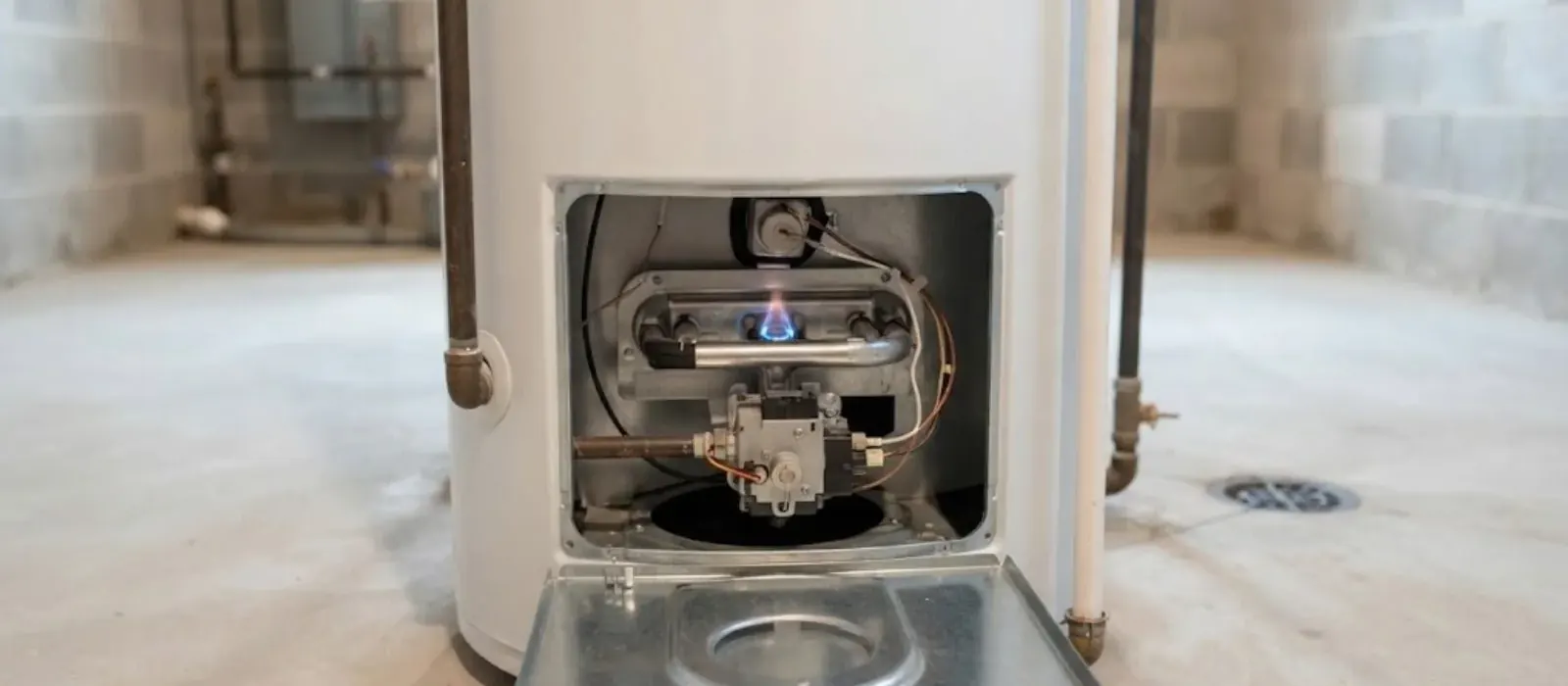
The parts that fail most often are the pilot assembly, the thermocouple, the burner and the gas control valve. The flue matters just as much, because it carries exhaust outdoors. Soot, scorch marks above the draft hood or a burning smell mean the heater should be switched off and checked before anyone uses it again. If you smell gas, the SoCalGas steps above come first.
Electric tank heaters
An electric tank has two heating elements, two thermostats and a high-limit switch, all running on a 240-volt circuit. Sediment on the lower element is the usual reason for slow recovery. The plumber confirms power is off with a tester before any cover comes off, then tests each element for continuity.
Hybrid heat pump heaters
A hybrid heater adds a compressor, a fan, a coil, an air filter and a condensate drain to an electric tank, with backup elements for heavy demand. A clogged filter, a blocked condensate line or a closet too tight for airflow can shut one down. Because there are more parts, some repairs wait on a maker part, and the plumber tells you that up front.
What Loma Linda heat, well water and old closets do to a heater
Summer here is hard on appliances. NOAA's Redlands station, the nearest long-record site, averages roughly 25 days each year at 100 degrees Fahrenheit or hotter across its 1991 to 2020 normals. A heater in a garage or attic closet sits in that heat for weeks, which wears thermostats, wiring and relief valves. Ask the plumber to check that the closet has room to breathe and no stored boxes pressed against the unit.
The same station logs only about 3 freezing days a year, so frozen pipes are rarely the cause of a dead heater here.
Tap water in the city is groundwater pumped from city wells and treated with chlorine. Its 2025 water quality report shows hardness in two places with different averages and wide spreads, so how fast scale forms depends on the well behind your street. Scale coats the bottom of a tank and the elements, which is why a heater pops or recovers slowly.
Test your tap, or ask the city for its annual report, before you assume your water is hard or soft.
Census estimates for 2020 to 2024 put 42.5 percent of the city's homes as pre-1980 construction. Inside those houses a heater is often the second or third one in the same closet, with older shutoff valves and flexible connectors. Expect the plumber to look at those parts too, because a repair that leaves a stuck valve in place can leave you with the next emergency.
How the cause is found before any part is replaced
A good repair starts with measurements, not guesses. The plumber uses a multimeter to test thermostats and elements, a gauge on a hose bib to read incoming water pressure, and a draft check at the flue to confirm exhaust is leaving the house. On a gas unit, the gas supply and the flame pattern are checked as well.
Next comes the tank itself. Draining a few gallons from the base shows whether sediment is coming out, and a look at the anode rod shows how much protection is left against corrosion. A moisture meter on the wall behind the heater tells you whether water has been escaping for a while. All of this informs the repair-or-replace call, which should be yours with the facts in front of you.
Repair or replace: an honest read
Most failures at the top of the tank are worth repairing. A thermostat, an element, a thermocouple, a relief valve or a set of connectors costs far less than a new heater, and the tank behind them may have years left. A tank that is more than 10 years old and leaking from the bottom is the opposite case, and a second repair would only delay the replacement.
Age by itself does not decide it. A well-kept eight-year-old heater with one bad element deserves the repair. A 14-year-old heater with rusty hot water, a rumbling tank and a corroded fitting does not.
| Problem | Best handled by | Trade-off |
|---|---|---|
| Failed thermostat or element | Repair | Quick fix, but old sediment may shorten the next element |
| Pilot out, bad thermocouple | Repair | Cheap part, but check the flue draft too |
| Relief valve dripping | Repair after a pressure check | New valve alone fails if system pressure is the cause |
| Leak at fittings or drain valve | Repair | Fine if the tank is sound and not heavily corroded |
| Water seeping from the tank body | Replacement | No repair exists for a corroded shell |
| Rusty hot water and an old tank | Replacement | Money spent on parts may be lost within a year or two |
If the answer is replacement, the water heater replacement page lays out through what that visit involves. If you would rather move to a different type of heater, see the tankless water heater page.
Nights, weekends and holiday heater failures
Heaters seem to fail on a Saturday night or the morning of a holiday, and the line is open 24/7 for exactly that. The plumber who comes out can shut off the leak, dry the area, and tell you whether the repair is a quick part swap or a bigger job. Same-day appointments are offered when available for the work that can wait until morning.
If the heater is leaking but contained, you can sometimes shut the cold valve, wait out the night with the breaker off, and book the repair for the next opening. If water is reaching a hallway, a bedroom or a panel, call right away. Calls also come from neighbors in Redlands and Grand Terrace, and we serve those towns the same way.
Why one repair costs more than another
- Which part failed, and whether it is stocked for your brand and model
- Gas, electric or hybrid, since hybrid diagnostics and parts differ
- Access, such as a tight closet, an attic platform or a heater in a garage corner
- Whether the work happens after hours, overnight, on a weekend or on a holiday
- Extra parts, like new connectors, a relief valve or a drain pan, that a safe repair needs
Homeowner insurance often pays for a sudden, accidental discharge and excludes slow leaks and wear. Your insurer decides which category your heater falls into, so take photos of the damage before you mop.
Want a real number for your own heater? Call (909) 505-3225 and a licensed plumber quotes a clear price before any repair begins.
Questions about water heater repair
Yes. The phone line is open 24/7, so a tank leaking at midnight, a cold heater on a Sunday or a holiday failure all get a call back with the same priority. A licensed plumber can stop the leak, make the unit safe and tell you what repair is needed, with a clear price before work starts.
It depends on where the water comes from. Drips from fittings, the drain valve or the relief valve can be repaired. Water seeping from the tank body means the shell has corroded and the heater needs replacing. Shut the cold water valve first, then call.
The usual causes are a pilot that has gone out, a worn thermocouple or flame sensor, or a failed gas control valve. If you smell gas at any point, leave the building and call SoCalGas at 1-800-427-2200 or 911 before you call a plumber.
Look at age, where the leak is and how often it has needed work. A new element or thermostat on a sound tank is worth doing. Leaks from the tank body, rusty hot water and a repeat repair on a tank past 10 years usually point to replacement.
Swapping a thermostat is not the same project as setting a new tank, and the answer can change with the job. The Loma Linda Building and Safety Division issues plumbing permits and can tell you for your case. If a job needs a building permit, a state-licensed contractor has to do it.
Use the license lookup on the Contractors State License Board website. You can search by license number or business name, and the result shows license status and any complaint disclosure. Plumbing work falls under the C-36 classification, which includes water-heating equipment.
It can shorten a heater's life if scale builds up. The city draws from wells and reports hardness that varies by well, so there is no single answer for every street. Test your tap, and ask the plumber to look at the lower element or the tank bottom for scale.
Cold water or a wet floor? Call for water heater repair
Tell us gas, electric or hybrid and where the water is showing. A licensed plumber gives a clear price before any work starts.
Call (909) 505-3225Dispatched from Loma Linda
Crews head out from Loma Linda to the neighborhoods below and the towns around them.