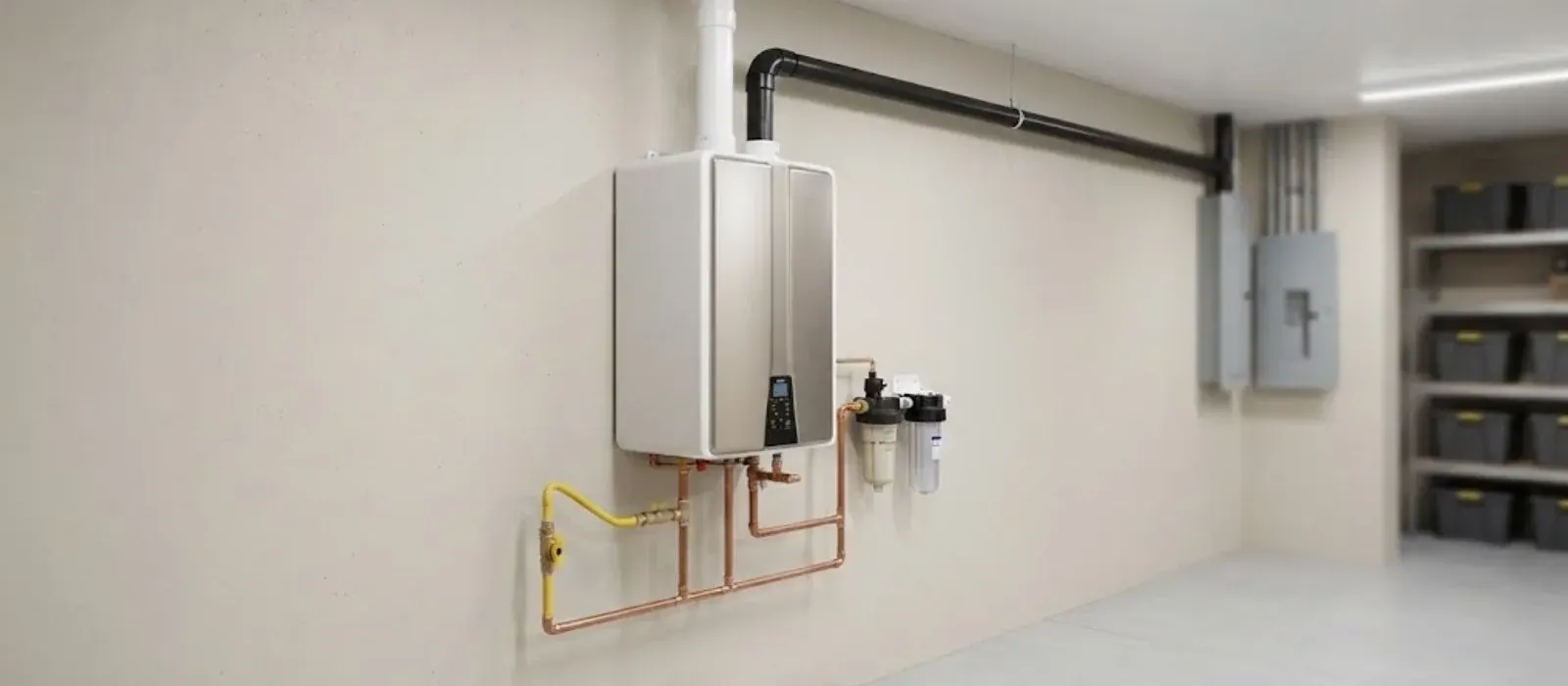
Tankless Water Heater Flush and Descaling for Loma Linda, CA Homes
A tankless flush circulates a mild acid through the heat exchanger to dissolve mineral scale, and it is worth doing most where the water is hard.
What a tankless flush does and why it matters
A tankless water heater heats water as it flows through a narrow heat exchanger. Minerals in the water, mainly calcium and magnesium, bake onto that metal and form scale. Scale narrows the passages, slows heat transfer, and makes the unit work harder. A flush, also called descaling, circulates a mild acid, most often white vinegar or a maker-approved solution, through the exchanger to dissolve the deposits.
Flushing is regular maintenance. It does not repair a failed part. If the unit still throws errors or runs cold after a flush, something else is wrong, and a plumber should look at it.
The maker's manual sets the flush interval and the solution. Follow it, because units differ, and the manual also shows where the service valves sit.
Signs your tankless heater needs a flush
Scale does not announce itself, but it leaves clues.
- Hot water that fluctuates or turns lukewarm during a shower.
- Error codes that point to flow, temperature, or the heat exchanger.
- Loud popping or rumbling, sometimes called kettling, from the unit.
- Lower hot water flow at the tap than before.
- Visible crust on the inlet filter or shower heads.
These signs also match other faults, such as a failing sensor, a clogged filter, or a problem with the gas supply. A flush is a first step, not a final answer.
Steps for a flush, and where DIY stops
Many homeowners with isolation valves already installed can flush a unit. Without them, the job needs a plumber. These are the general steps. Read your own manual first, because details differ.
- Turn off power to the unit and shut the gas valve to it. For gas units, confirm the burner is off.
- Close the cold water inlet and hot water outlet isolation valves.
- Connect hoses to the service ports and open the drain ports to relieve pressure into a bucket.
- Run a pump to circulate the descaling solution through the unit for the time the maker lists.
- Drain the solution, rinse with fresh water, and clean the inlet filter.
- Reopen the valves, restore gas and power, and run hot water to purge air.
Hot water scalds. Let the unit cool first, and wear gloves and eye protection when handling the solution.
What not to do
Do not skip the gas shut-off. Do not light a burner while hoses are attached. If you smell gas at any step, leave the building, then call SoCalGas at 1-800-427-2200 or 911 from a safe place before calling a plumber.
Do not work on the gas line, the vent pipe, or the burner assembly. Gas piping and venting are licensed work. Do not mix descaler with bleach or other cleaners, since some combinations make toxic gas.
Do not flush a unit with no isolation valves by cutting into pipes. Adding valves is a plumbing job that may need a permit, and the plumber can do it during the same visit.
DIY flush or professional service
| Task | Homeowner | Plumber |
|---|---|---|
| Cleaning the inlet screen | Yes, with the water off | If hard to reach |
| Flush with isolation valves in place | Possible, with the manual | If unsure or unit is old |
| Flush with no isolation valves | No | Yes, valves added first |
| Error codes persisting after flush | No | Yes |
| Gas supply, vent, or burner trouble | No | Yes, and call SoCalGas for any gas smell |
For installation questions and questions about adding valves, see our page on tankless water heater service. If the unit still misbehaves after a flush, water heater repair covers fault diagnosis.
Loma Linda local note: hardness varies by well
Scale is a water-quality story, and in Loma Linda the story varies. Total hardness in the city's 2025 water quality report averages near 78 parts per million in one table, with readings from about 8 up to 200. Another listing lower in the document shows higher figures. Because the city draws on several wells in the Bunker Hill Basin, hardness differs by well and so may differ by street.
That means a single hardness number would mislead you. Test your own tap, or call the city's water questions number, (909) 799-4420, to learn which wells serve your street. A home on harder water may need a flush more often, and a home on softer water may need it less. Your manual and the heater's own behavior give the real schedule.
Neighbors in Redlands see a different picture. The Redlands water report lists groundwater hardness averaging 148 milligrams per liter, with a range of 100 to 200, and treated surface water averaging 117, with a range of 94 to 140. The same unit may need a different flush schedule on each side of a city line.
Hardness, filters, and softeners
A water softener or scale-reduction filter ahead of the heater can slow scale buildup. It does not replace flushing, because some scale still forms. Softeners add their own maintenance, and a plumber can tell you whether one makes sense for your tap.
A sediment filter at the inlet protects the heat exchanger from grit. Clean it when you flush. A clogged filter lowers flow and can trigger the same error codes as scale.
If you rent, tell the landlord if the unit is the building's equipment. Do not alter a landlord's heater, and report error codes or loss of hot water in writing.
Keeping a record
Write the date, the solution, and anything you saw, such as a color in the drain water. A record helps a plumber spot a change. Take a photo of the data plate once, since it lists the model needed for parts and manuals.
If the drained solution looks heavy with debris or flakes, the unit had a lot of scale. Consider shortening the interval or adding a filter. If it comes out clear, you may be flushing more than you need.
Permits, licensing, and cost
A new tankless install usually involves gas, venting, and sometimes electrical work, and permit rules vary by city, and the Loma Linda Building and Safety Division can say what applies. A job that needs a permit must go to a licensed contractor, and the CSLB online lookup shows whether a plumber holds a valid license.
Price for a service visit depends on several things.
- Whether isolation valves are already installed.
- Unit age and condition.
- Water hardness and how long since the last flush.
- Gas, vent, or electrical issues found along the way.
- After-hours or weekend service.
To learn what a flush or repair means for your unit, call (909) 505-3225 and hear a clear price before the work begins. The line is open 24/7. Scale damage is wear, so do not expect an insurer to cover it. Our service area includes Highland too.
Questions about flushing a tankless heater
Follow the maker's manual for the interval. Harder water usually means more frequent flushing. Because Loma Linda hardness varies by well, test your own tap before choosing a schedule.
Many makers allow white vinegar, but some specify their own descaler. Check the manual for the solution, the amount, and the circulation time. Do not mix it with other cleaners.
Yes, in practice. They let you route solution through the unit without cutting pipes. If yours has none, a plumber can add them.
The flush itself is manageable for some homeowners, but gas, venting, and burner work are not. Shut off the gas and power first, and if you smell gas, leave and call SoCalGas at 1-800-427-2200 or 911.
Test your tap with a home kit, and ask the city about the wells serving your street. The city's water quality report lists hardness values that vary widely.
Tankless unit throwing errors or running cold?
Call any hour. A plumber can flush, test, and give you a clear price before work starts.
Call (909) 505-3225Dispatched from Loma Linda
Crews head out from Loma Linda to the neighborhoods below and the towns around them.